
AUTHOR
Dr George Ninan
Director, ICAR Central Institute of Fisheries Technology, Kochi
Introduction
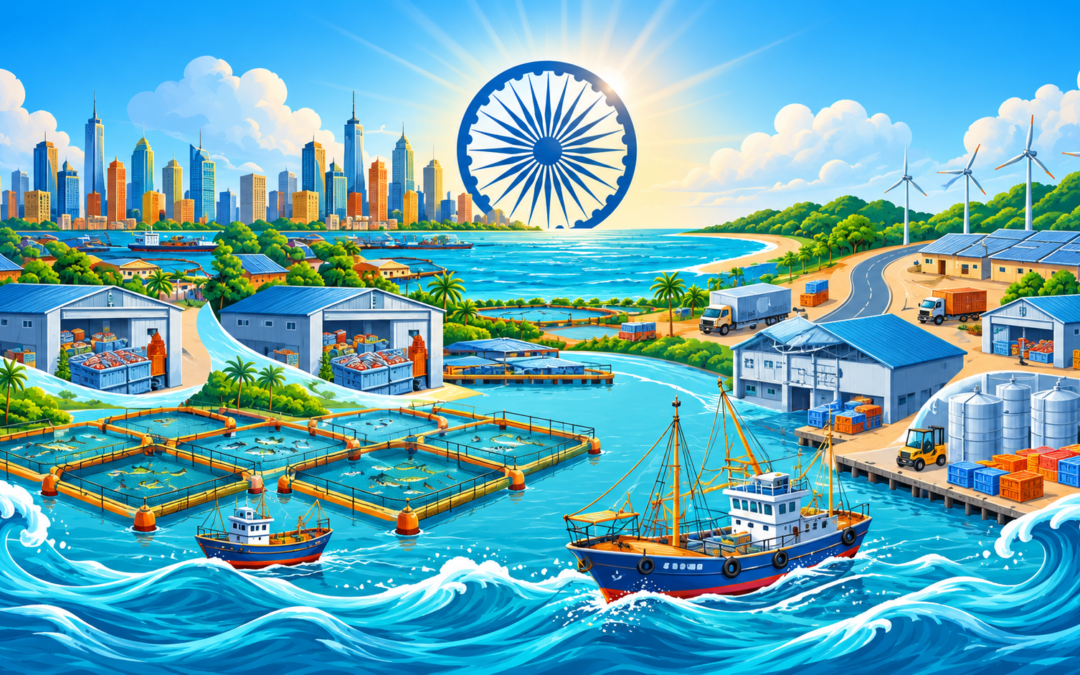
Blue Revolution 2.0 envisions transforming fisheries into a powerful engine of growth for Viksit Bharat @2047, aligned with the economic goal of moving India toward a USD 30 trillion economy. Leveraging the Blue Economy for both food security and GDP expansion, the mission focuses on clear, measurable targets: raising fish production to 22 million tonnes under the proposed Second Blue Revolution, scaling seafood exports to ₹1 lakh crore (from the current peak of ~₹72,325 crore), and achieving 100% fish waste utilization through advanced value-addition and processing systems. Just as importantly, it aims to ensure livelihood security for over 30 million fishers and marginalized communities, enabling a paradigm shift from subsistence fishing to high-value entrepreneurship, where fishers evolve into FinTech & AgTech entrepreneurs rather than remaining dependent solely on catch-based income.
Strategies
To make this vision real, the strategy combines large-scale systems building with people-centered inclusion. It starts with infrastructure and value chains, including integrated cold chains, modern automated warehousing, and deep-sea fishing corridors supported through major harbor expansion under Sagarmala 2.0. It also adopts a cluster approach, implementing a Five-Year Cluster Development Program under PMMSY (Pradhan Mantri Matsya Sampada Yojana) to close gaps across the full value cycle, from pre-production and harvesting to post-harvest logistics. Alongside physical upgrades, technological modernization will be accelerated through AI-enabled ocean modeling, IoT-based monitoring, automated hatcheries, and advanced seaweed cultivation. The plan also expands inland fisheries by optimizing output across India’s freshwater assets comprising 2.2 million hectares of ponds and tanks, and 29,000 km of rivers. Finally, the transition is made inclusive through women-led economic empowerment, strengthening Women FFPOs (Fish Farmer Producer Organizations), SHGs, and dedicated aquaculture startups ensuring that entrepreneurship grows with equity and opportunity.
Blue Revolution 1.0 vs Blue Revolution 2.0
Blue Revolution 1.0 was primarily focused on production and expansion, emphasizing volume growth, higher yields, and catch expansion. This approach supported historic progress, taking fish production to around 19.5 million tonnes by 2025, through broad national schemes managed in a more decentralised manner. It relied heavily on infrastructure such as fish landing centres and local harbour facilities, while most production continued through traditional pond aquaculture and coastal netting. However, the ecosystem and market side often lagged behind, leading to fragmented supply chains, high post-harvest losses, and growing risks like coastal degradation and unmonitored overfishing.
In contrast, Blue Revolution 2.0 shifts from merely producing more to building value, resilience, and technology-led fisheries. Its core philosophy centers on holistic income, climate-smart resilience, and delivering better quality and value. The flagship ambition is to reach 22 million tonnes and beyond through precision aquaculture, driven primarily through the ₹20,050 crore PMMSY framework. It strengthens infrastructure through integrated tech hubs, automated cold chains, and Sagarmala-linked projects, while upgrading production methods using advanced systems such as RAS, biofloc, and IoT-enabled monitoring for better traceability and control. Market organization also becomes more structured through FPO-led models and localized cluster development, and ecologically, the approach introduces stronger safeguards such as biosecurity, mariculture zoning, and carbon-neutral targets.
High-potential entrepreneurial avenues
A strong interconnected opportunity ecosystem for technology-led and sustainable fisheries can be developed across the following five high-potential entrepreneurial avenues.
- Smart Aquaculture: Intensive & Automated
Adoption of Biofloc systems, high-density Recirculating Aquaculture Systems (RAS), and automated sea cages to increase production per cubic metre, improve resource efficiency, and reduce land requirements.
- Precision Fisheries: Data & AI driven
Application of Artificial Intelligence, remote sensing, water-quality monitoring drones, Potential Fishing Zone (PFZ) data, and disease-alert systems to enable faster decision-making and create new technology-based B2B fisheries services.
- Post-Harvest Logistics: Cold Chain & Market Access
Development of solar-powered micro-cold storage facilities and digital marketplaces to reduce post-harvest losses, improve product quality, strengthen cold-chain connectivity, and provide direct access to markets.
- Waste to Wealth: Circular & High-margin enterprises
Conversion of fisheries and seafood processing residues into high-value bioproducts such as collagen, chitin-based packaging materials, and premium fish oils, creating additional revenue streams while promoting circular economy principles.
- Green Enterprises: Climate-smart & Investible businesses
Development of sustainable enterprises based on clean energy, water recycling, seaweed cultivation, alternative feeds, and eco-friendly packaging, supporting climate resilience, resource efficiency, environmental sustainability, and investment opportunities in the fisheries sector.
How ICAR can handhold startups in fisheries & aquaculture
ICAR can play a pivotal role in handholding and accelerating startups in fisheries and aquaculture by bridging the gap between scientific research and commercial enterprise. Through Technology Transfer and Licensing, ICAR can provide startups with access to patented technologies, research innovations, and ready-to-commercialise solutions. Incubation and Mentorship through Technology Management Units and Agribusiness Incubation Centres (ABIs) can offer technical guidance, workspace, business mentoring, and entrepreneurial support. Pilot-scale production and prototyping can enable startups to access pilot-scale processing facilities, R&D infrastructure, and technical expertise to develop, test, and refine innovative products. ICAR can also support Go-to-Market strategy and commercialisation through guidance on branding, market positioning, packaging innovation, and business-model development, helping startups successfully enter domestic and international markets. Through skill development and capacity building, ICAR institutes can conduct entrepreneurship development programmes, hands-on workshops, technical training, and specialised programmes tailored to fisheries and aquaculture entrepreneurs. Policy and regulatory guidance can help startups navigate licensing requirements, sustainability standards, food safety regulations, and international trade requirements. Market linkages and industry connect can facilitate collaborations with industry stakeholders, seafood processors, exporters, retailers, investors, and other market players, creating opportunities for business growth and scale-up. Finally, through Testing, Validation and Certification, startups can access ICAR’s specialised laboratories, research infrastructure, and field-trial facilities for product testing, performance validation, quality assurance, regulatory compliance, and certification, thereby strengthening the credibility and market readiness of their innovations.
For More>>