
AUTHOR
Saranya Prabha
Research Scholar, Amrita School of Business

Introduction
India’s seafood exports reached unprecedented levels in the financial year 2023-24, shipping 1,781,602 metric tons worth ₹60,523.89 crore (US$7.38 billion), despite several challenges in key export markets. Frozen shrimp remained the primary export product in terms of volume and value, while major importers included the USA and China. Compared to the previous year, when India exported 1,735,286 metric tons worth ₹63,969.14 crore (US$8.09 billion), the export quantity grew by 2.67%. The USA, China (excluding Hong Kong and Taiwan), Japan, Vietnam, Thailand, Canada, Spain, and Belgium comprised the key markets for Indian seafood exports. In February 2025, the US reported 96 seafood refusals, including four shrimp consignments due to the presence of banned antibiotics, three of which originated from India. In 2024, India continued to dominate the US shrimp market, supplying 246,224 tons valued at USD 1,899 million, capturing 27% of the market. Other major suppliers, such as Ecuador, Indonesia, Vietnam, and Thailand have maintained varying levels of competitiveness, with Ecuador’s fully integrated systems and Indonesia’s traceability adoption offering significant competition. Thailand’s market share has reduced due to structural constraints and competitive shifts. India’s leadership is driven by large-scale aquaculture, competitive pricing, and a strong export orientation, which collectively form a strong base for further value addition through digital traceability.
Digital traceability
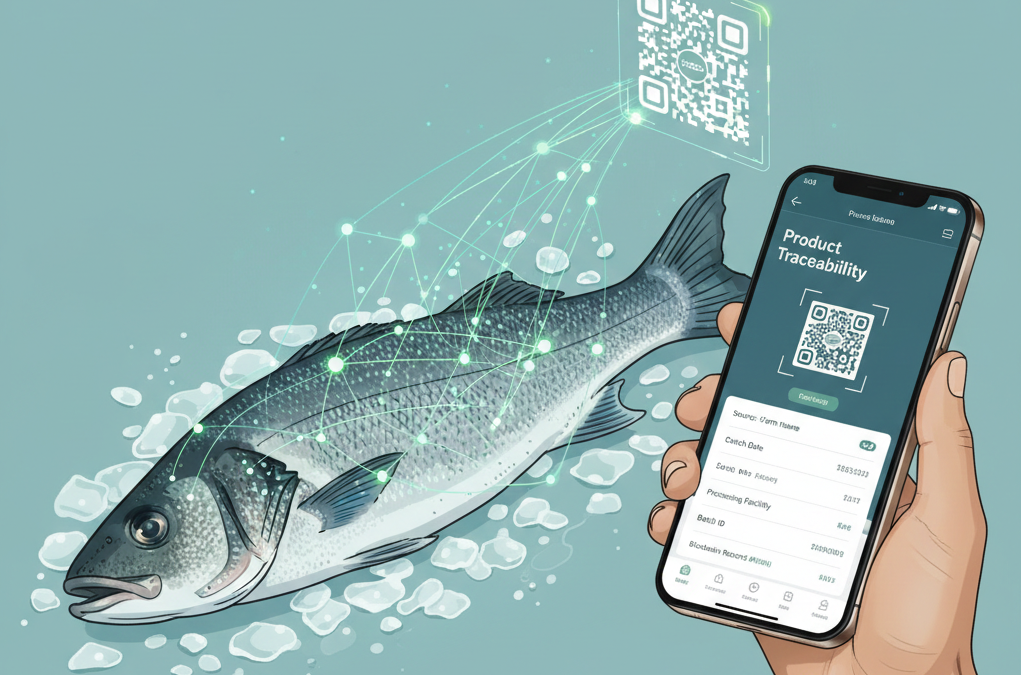
Digital traceability encompasses tracking the product from catch to consumer, recording location, handling, storage, and processing activities, while maintaining verified records of quality and compliance. Global trends underscore the urgency of adopting digital traceability. By 2026, the EU mandates full digital traceability for nearly all seafood products, while the US FDA, under FSMA, has extended compliance timelines to allow industry readiness.
Consumers are willing to pay a premium for traceable, certified products, with studies showing that MSC-labelled seafood commands an average 11% price increase globally. Trust is built when different systems across the supply chain interoperate using global standards such as the Global Dialogue on Seafood Traceability (GDST) and Global Standards (GS1), ensuring data integrity, comparability, and acceptance across international markets. ISO 22005 offers principles for designing feed and food traceability systems applicable across the food chain, while GS1 standards define critical tracking events and key data elements, enabling sector-specific traceability that aligns with international expectations. Implementing these systems positions Indian seafood as a value-driven, trusted global supplier.
Programs supported by GoI for seafood sector development and traceability
To maintain and expand its market position, India has initiated several programs supporting seafood sector development and traceability.
(i)The Pradhan Mantri Matsya Sampada Yojana (PMMSY) involves substantial investments to upgrade fisheries infrastructure, improve certification and traceability systems, and enhance value addition. The program also supports fishers with better boats, cold chains, integrated aquaparks, and enhanced management practices.
(ii) The Pradhan Mantri Matsya Kisan Samridhi Sah Yojana formalizes digital identities for fishers and integrates them into the National Fisheries Digital Platform.
(iii) The MPEDA’s Network for Fish Quality Management and Sustainable Fishing (NETFISH) focuses on knowledge transfer, training, and sustainable fishing practices for fishers, processing workers, and technicians.
(iv)APEDA’s TraceNet provides a digital certification platform for organic seafood, collecting and storing forward and backward traceability data along the supply chain.
(v) The eNAM platform integrates agricultural markets nationwide, creating a unified trading platform that standardizes procedures, facilitates transparent quality-based auctions, and enables real-time pricing.
Furthermore, FSSAI regulations and Food Recall Regulations mandate traceability for fish products, organic foods, vegan claims, and fortified rice, ensuring that the seafood supply chain is compliant and accountable.
These programs collectively address the need for verifiable compliance, which is increasingly demanded by high-value export markets such as the EU and the US. While paper-based documentation cannot ensure zero antibiotics or perfect cold chain integrity, digital traceability provides a reliable, verifiable solution, turning operational promises into credible, marketable facts.
For More>>